Thursday, January 9, 2020

Haiti Guide: Safety tips for car travel in Haiti

After a recent incident where friends of mine were robbed at gunpoint in their car in Port-au-Prince, I thought it could be useful to share some tips and tricks I have learned over the years about traveling by car in Port-au-Prince / Haiti / "dangerous" areas. I am sure there is much more advice that can be given, so please feel free to add on in the comment section below. Safe travels!


PLAN AND ACT ACCORDINGLY

1. Avoid unnecessary travel to reduce chance of something occurring (take a charter flight if possible)
2. Use an experienced driver who knows alternative routes and which areas to avoid
3. Check your contacts / resources about the status of the roads before you travel (pro tip: Keep the radio on in the car, listening to a station that provides ongoing news updates)
4. Travel with a local who knows the area well and can potentially help deescalate / negotiate through a bad situation
5. Try to avoid travel in known traffic areas during rush hour to reduce chance of being stuck in traffic, a vulnerable position
6. Avoid travel at night
7. Travel with emergency cash, enough to re-fill your gas tank and stay at a hotel if needed
8. If traveling with goods / merchandise, ensure they are covered and/or out of site
9. Keep doors locked at all times (pro tip: If you are traveling through a bad area and you realize that your door is unlocked, lock it in an “quiet” way, i.e. resting your elbow on the window and locking the door with your elbow)
10. Minimize / avoid withdrawing large amounts of cash at the bank (there have been incidents where “informants” inside banks notify robbers of people who withdrawal larges amount of money and then they are promptly robbed when travelling away from the bank)

HAVE A GOOD VEHICLE

11. Use a reliable vehicle with 4x4 capability / high clearance and the ability to quickly drive away
12. Ensure your vehicle has a full tank of gas before entering congested / bad areas to avoid having to get fuel at an inconvenient time or location
13. Ensure your vehicle has good tires to reduce chance of a flat tire and having sit idle on the side of the road while changing a flat tire, a vulnerable position
14. Try to have tints on windows to make it difficult to know who or what is inside (special authorization by the police is need for this in Haiti)

PROTECT YOURSELF

15. Minimize the amount of cash you travel with
16. Store cash and valuables in multiple locations on you and in the car
17. Do not wear valuables or items that appear to be valuable, i.e. watches, jewelry, suit, etc.
18. Stay off your cell phone (pro tip: If you must be on your phone, make sure your windows are up and the phone is on the side of you furthest away from the window)
19. Travel with an old cell phone and fake wallet to be able to give them away in the event of a robbery
20. If robbed, comply with the robbers, DO NOT RESIST as people have been shot and killed this way.


I am sure there are more tips, so please feel free to share your ideas and improve mine!

*Disclaimer: By no means is this an exhaustive guide that will provide you with 100% safety. Remember that when you travel, you do so at your own risk.

Be safe and travel well!

Thursday, November 14, 2019

Haiti Guide: Charter Flights in Haiti


With the increased need/desire for in-country flights due to the current civil unrest in Haiti, it seems that people, including myself, have been looking for more information on charter flights in Haiti. Having coordinated dozens of these flights over the years for work and personal trips, I wanted to share the tips and tricks I have learned, as well as the current information I have gathered from recent trips. I know there is more information and insight available, so I look forward to hearing what you share too!


QUICK RUNDOWN OF CHARTER FLIGHTS IN HAITI

Simply put, if you need a flight, contact the following people / organizations and work with them to schedule a flight.

Mission Aviation Fellowship (MAF)
HT-bookings@maf.org
*My preferred choice, but currently have limited availability.

Pilot Celestin
+509-3745-8090

Pilot Jacky
Scheduling by Sylvie
+509-4885-1821
+509 37 68 0000

Pilot Roger Bartels
Scheduling by Jiklene
+509-4754-4770 or FlightRequest@GSAC.com.ht

A charter plane in Haiti, at the Jacmel Airport


IN-DEPTH LOOK AT CHARTER FLIGHTS IN HAITI

This how it all works…as best I understand it.

COST: When chartering a flight in Haiti, this means you are paying for the "entire plane." It doesn't matter if you have 1 passenger or 4 passengers, the cost stays the same. This is because the expenses for pilot / organization remain the same, independent of the number of passengers. Therefore, the best way to reduce costs on these charter flights is to try and fill the plane with passengers, therefore, reducing the per passenger cost. For example, if you charter a 5-passenger plane for $800 and only have 2 passengers, the cost per passenger would be $400. If you have 4 passengers, the cost would be $200 per passenger. And so on. Whatever the cost, be prepared to pay cash for the flight, especially for the independent pilots. (TIP: If your schedule is somewhat flexible, call the pilots and ask around for charter flights that may already be scheduled and try to buy a seat on the flight. This is of benefit to the person / group chartering the flight as they can reduce their per passenger cost and can be of benefit to the pilots as they may have other people looking to book a flight, but cannot commit to it because they need to find people with whom to share the costs.)


WEIGHT: These planes are typically small will most likely have a weight limit. Therefore, the more passengers you have the less weight and space you have available for luggage. For example, I know that one 5-passenger plane in Haiti has a weight limit of 950 pounds (430 kg) for passengers and cargo / luggage. That would mean with 4 passengers, each passenger, plus their luggage could weigh an average of 238 pounds (108 kg). With 5 passengers, each passenger plus their luggage could weigh an average of 190 pounds (86 kg). Because of these weight constrictions, it is common that the pilots and/or their staff weigh you and your luggage before getting on the plane. (TIP: They are not interested in how much you weigh, they just want to know how much weight you and your belongings add to the plane. Therefore, if you are self-conscious about your weight, step on the scale with your carry-on bag so that no-one will know your actual body weight.) (Check out these additional packing tips from MAF.)


My girlfriend and I boarding a plane in PAP

SCHEDULING: Ideally, you want to know your travel dates and times weeks or months in advance and plan your trips accordingly. With that being said, based on recent experiences, it seems like it is best to not only book your flight weeks in advance, but also have back-up options lined up in case weather, mechanical issues, or pilot's scheduling conflicts impact your flight. Just as you may be trying to shop around for a best price, the pilots are likely shopping around for the best flight times that enable them to maximize their time in the air, aka when they make money. This could lead to your flight time getting changed. Regarding the weather, while it doesn't happen often,  some flights are have to be rescheduled when it is rainy or very cloudy. With all this being said, patience and flexibility are key when scheduling these flights. (TIP: If you are booking a charter flight in relation to an international flight, most of these charter flights ask you to schedule the flight 2 hrs after / before your arrival / departure.) (Check out these additional scheduling tips from MAF.)

AIRPORTS: I believe that nearly all the charter flights are based at the Guy Malary Airport (Aerogare) in Port au Prince. The charters use the same runway as the international airport, but arrivals and departures for these local charter flights take place at Guy Malary Airport, which is just a two minute drive from the international airport. For other airports in the country, I am aware of Jeremie, Les Cayes, Jacmel, Gonaives, Mole St. Nicolas, Port de Paix, and Cap Haitian. *Update: Gonaives is a private airstrip and arrangements must be made with the Ebenezer Mission to use it, +509-4274-2513. (I know there are more, so please comment as to which airports / landing strips you know are functional.)

Flying into the Jacmel Airport

So there you have it, this is all the current information I have about charter flights in Haiti. But I am sure I am missing valuable information and insight. Please add / comment on this topic in the comments section below so that we can update this information and make it as useful as possible. Thanks and safe travels!

Tuesday, January 16, 2018

Haiti Guide: International Jazz Festival of Port-au-Prince


The International Jazz Festival of Port-au-Prince is the biggest, and by far the best, music festival in Haiti. Since 2007, the Haiti Jazz Foundation has been putting on this week-long event that is jam-packed with concerts and all sorts of activities for music lovers. It features musicians from countries such as Brazil, Canada, Chile, Switzerland, the USA, and of course, Haiti. In addition to the main concerts, there are after-hour jam sessions, workshops, conferences, and classes with the musicians. The events take place at multiple venues located all over the greater Port-au-Prince area, including the luxurious Hotel Karibe, the public park Place Boyer, the campus of Université Quisqueya, and the Royal Decameron Resort, located on the beautiful beaches of Côte des Arcadins. 

As their website states, the Port-au-Prince International Jazz Festival, a non-profit event, features an unprecedented cultural assembly to a local and international audience and is one of the best examples of successful partnership between the international community via embassies of Belgium, Canada, Chile, France, Germany, Mexico, Panama, Spain, Switzerland and the United States of America, the public sector through Haitian Ministry of Culture and Tourism, and local private institutions and sponsors such as Prestige (Heineken), Rhum Barbancourt, Sogebank, Mercedes-Benz, Air France and Delta.


I had the chance to speak with Milena Sandler, the General Manager of the Haiti Jazz Foundation, who is very excited about this year's event. First, unlike the past two years, there have been no interruptions in planning due to presidential elections. Preparations have been going very smooth and there should not be any interference, aka protests, that impede attendees from traveling through the city to get to events. (This is a huge plus for the organizers and for concert-goers!) Ms. Sandler is also excited as, for an added bonus this year, the festival will feature two events in Jacmel: Tuesday, January 23rd at Alliance Français, and Wednesday, January 24th at the Jacmel Wharf. Most importantly, Ms. Sandler wants to remind people that nearly all of the 40 concerts are free and that she and her team have been working extremely hard to ensure attendees will have a great time. 


Université Quisqueya. All photos credited to the PauP Jazz Festival

Have an inkling to attend part of or all of this year's festival? Then start making your plans now! This year's event, featuring 30+ artists from 14 countries, runs from January 20th to the 27th…yes, that's just a few days away! To make your plans and/or secure tickets in advance (which is recommended), simply check out the event's website, http://papjazzhaiti.org/, or Facebook page, https://web.facebook.com/papjazzhaiti/. They even have an app called, PapJazzHaiti, with android and ios versions. (The website is very well organized and has all the information you will need…it even includes a countdown timer to the event!) 

If you can't decide on which event to go to, Ms. Sandler recommends either the opening or closing night. Both concerts will have Grammy Award winning performers, and, as she puts it, "they are not to be missed." 

My friend Betsy, who has been living in Haiti for many years and has attended the event multiple times, also recommends checking out some of the smaller event venues, aka the after-hour jam sessions. You will be rewarded with a more relaxed and intimate concert experience, and will also be in a great environment to meet new people and save a few bucks on entry fees.

I have not yet had the opportunity to attend this seemingly amazing event - I didn't even know about it during my first few years in Haiti...hence the blogpost. If you do indeed attend, please share your experience with me, and for that matter, your friends and family too. I am very interested in seeing/hearing about your experience, and in light of recent events, I am sure lots of other people are interested too.

Oh, and one last note. If you plan to stay at the same hotel where the festival is that night, bring your earplugs. The hotels will most likely be more interested in catering to the live music rather than their guests!

"If you want a festival experience that feels like an adventure, a trip, a step into the unknown, one that mixes star names with sounds you've never heard before, you should come. And if you do, I expect you'll find it a hard place to forget." 
- Thomas Rees, JazzWiseMagazine.com. 

- - -

Many thanks to my friend Betsy Sherwood for her insight and encouragement for this post.


You might be thinking I have some invested interest in this event, but I don't. My only interest is supporting a great event in Haiti and making sure people are aware of it.

Sunday, January 14, 2018

Haiti Guide: The Haiti I Know

Over the past seven years I have been involved in Haiti, having lived here for the past three and a half years. There is no denying that Haiti is the poorest country in the Americas (source: World Bank). But just like nearly everywhere else in the world, Haiti has good places and bad places. Good people and bad people. Good experiences and bad experiences.

For many people in Haiti, life is a daily grind where the pursuit of good health and prosperity is impeded by limited opportunities and scarce resources. At the same time, Haiti has tremendous beauty, both in it's natural landscape and it's people.

In light of the recent vulgar comments by Trump, I wanted to share some of the places I have been to, people I have encountered, and experiences I have had during my time in Haiti.

For those familiar with Haiti, I hope the content below is an accurate representation of Haiti. For those not familiar with Haiti, I hope sharing with you the Haiti I know can help you begin to better understand Haiti.

The amazing team of dedicated, honest, and hard working people I have had the privilege of working with during the past six months in Les Cayes.

When a sick baby didn't show up for their follow-up appointment, our team took it upon themselves to track down the baby to make sure they were OK.

The view from atop the Citadelle, a magnificent fort built by the people of Haiti at the beginning of the 1800s, shortly after Haiti became the first nation to gain it's independence by way of a slave revolt. 

Ile de Rat - Tourist destination off the coast of Cap Haitian.

"Coffee Shop" in southern Haiti.

The owners of the coffee shop. Many people work 6 or 7 days a week just to make ends meet.

Some people live in shacks.

Some people live in modern luxury.

Nearly every student or young person I have met in Haiti is eager to learn. Unfortunately, limited resources and opportunities often prevent them from pursuing desired training and education.

La Vallee de Jacmel kite festival, every year on January 2nd. One of the most peaceful and enjoyable events I have ever attended. 

The Baldé Family that I met back in 2012. They don't have much to offer, but they are some of the kindest and most generous people I know.


I cannot come close to capturing everything I have seen in Haiti in one post. If you are interested in learning more about Haiti and my experiences here, check out the following blog posts:


As always, thank you for taking the time to read my blog. I look forward to hearing your comments and feedback.

Thursday, January 11, 2018

Haiti Guide: Running Events in Haiti


For those interested in participating in an organized running event in Haiti. These are the major events I am aware of. If you know of others, please share!


Haiti 3-Day Ultra Run -- Thursday, March 1st, 2018
by Run Haiti
Amazing route along the most popular hiking trail in Haiti. With that being said, will be an event for serious runners.
-----

Jacmel Bay 5k -- Friday, March 9th, 2018
by Run Haiti
The day before the Jacmel 20k. A great event for those not interested in the 20k.
-----

Jacmel Riverbank 20k -- Saturday, March 10th, 2018 
by Run Haiti
me in the Jacmel 20k in 2016
(credit: RunHaiti)
In my opinion, the best running event in Haiti. Well organized and a beautiful course. Just be sure to do lots of training on hills!
-----

Les Cayes 1/2 Marathon & 5k -- Sunday April 15th, 2018
I believe this is the first event by this group. According to their email response to my question, "it is definitely going to take place." Hopefully it does and hopefully it goes well.
-----

LGH Marathon in PAP
(Credit: LGH Marathon)
Let's Go Haiti Marathon  -- TBD
Has put on events in the past, but their most recent event was cancelled. Not sure if and when they will put on another event. 
-----

If you are looking for tips on how to run in Haiti, check out the following blog post: Haiti Guide: Running in Haiti

Haiti Guide: Running in Haiti

If you are curious to know if you can run in Haiti, you most certainly can - I have trained for and run a marathon and half-marathon while in Haiti. With that being said, how to go about running in Haiti can most certainly be an adventure.

Running in rural areas is, for the most part, amazing. Dirt roads, beautiful views, and most importantly, little to no cars or motos. As my friend Lisa, who is one of the most dedicated and bad-ass runners I know, put it, "Trail running in Oregon on the coast was awesome, but I seriously think Fond des Blancs, Haiti has some of the best trail runs anywhere in the world." 
Jacmel Marathon in 2015 by Let's Go Haiti Marathon
(credit: Gwenn Goodale Mangine
)

On the other hand, cities in Haiti do not exactly have the most supportive environment for running. Sidewalks or roads with ample space, or for that matter any space, for runners are practically non-existent. Additionally, motor vehicle traffic does not exactly try to accommodate pedestrians. However, even in these circumstances, it can be done, you can run in cities in Haiti.

Running early in the morning is the best way to maximize your chances of finding some safe space on the streets. While some people advise to wait until there is at least some sunlight, I like the motto, the earlier the better. At 4:00 or 5:00 in the morning, there is practically no one on the roads. However, you will find dogs! They will nearly always bark at you and sometimes chase after you. So be prepared to encounter them whether you are in PAP, smaller cities, or rural areas. (I swear the dogs in Haiti are nocturnal. You will see them sleeping during the day and will find them more active at night.)

Ready to pounce! ...ok ok, it is
about to fall over sleeping
(credit: LiveSayHaitiBlog)
To deal with dogs when I was living in Fond des Blancs, a rural area, my running friend Lisa and I would always carry small rocks with us to help prevent dogs from chasing after you. (Throwing the pebbles at barking dogs most certainly helps deter chases!) However, if a dog does indeed chase after you, STOP RUNNING, turn around, "get big" by standing tall and spreading your arms out wide, yell at them, and throw your rocks at them. If you don't already have rocks in your hands, one of the benefits of Haiti is that you can usually find rocks or sticks nearby. And if by chance you can't find anything to throw at the dogs, snap your fingers at them while simultaneously pretending you are throwing something at them. I don't know how, but this snapping trick works. 

Lastly regarding dogs. If you plan to run/walk in Haiti, get the rabies shots as an extra step of precaution. Trust me, finding the appropriate treatment after you have been bitten by a dog is challenging….sorry mom, don't think I ever told you I was bit by a dog here in Haiti.🙈

Additional running tips:

The water "sachets" (small bags of water) make for great water sources during long runs as they fit perfectly into your hand. If you don't want to carry water or food, carry money with you for long runs as you will often find small boutiques with everything you need. Just be sure to scout the route first.

As in the United States, Sundays are your best chances to find the least amount of traffic on the roads.

If you do decide to run while it is still dark, be sure to have a reflector vest and/or a light. And if at all possible, run with a partner.

When running on roads with vehicle traffic, be prepared to have motos come uncomfortably close to you. Therefore, also be prepared to get out of the way! Drivers are not necessarily trying to hit you, but they are not looking to avoid you either. Remember, in Haiti it is the pedestrian's responsibility to avoid vehicles.

Jacmel Boardwalk
(credit: Familypedia)
Do some experimenting and/or research to find the best streets to run on in your area. -- In Petion-Ville, there is a park named Place Boyer with workout equipment. In addition to the equipment, there is a small loop around the park that is fairly conducive to running. And for an added benefit, in the morning, you will find other runners and people working out on the equipment. -- In Tabarre, there is a park right next to Aristide University. It has soccer fields, basketball courts, and a lot of open space. In the morning it is swarming with people working out. I think a lap around is close to a kilometer. Just be sure to wait for daylight in this area. -- In Jacmel, the boardwalk in the center of town is a great space to run during the week. It is a small back and forth, but there are no cars or motos allowed! And just like Place Boyer, there is workout equipment. So in the morning you will find yourself among dozens of runners, walkers, and people using the workout equipment. For long runs in Jacmel, the main road out of town towards Cyvadier is great, especially under the moon light. -- I haven't run much In Les Cayes, but my friends sometimes run on the road to Gele Beach which is nicely paved and doesn't have much traffic.

Running in the rural areas is great as there are little to no vehicles and it gives you a chance to explore. With that being said, because it is mostly trail running, it is best to run with some daylight. Additionally, learn how trails/roads are affected by rain as it can seriously impeded your ability to run your regular routes. Exploring new areas is great, but only take unfamiliar trails when you have time to get lost…not that this ever happened to me... To avoid getting lost, try and take turns at places with easily identifiable landmarks. You won't be encountering any large statues or shopping malls, but a uniquely colored house or a school or a church will do the trick.

Tip from my friend Ernesto: don't run too close to pigs...they have been known to chase runners (aka my friend Ernesto) and surprisingly, pigs can sprint well!

Jacmel 20k in 2016 by RunHaiti
with my friend Lisa
Avoid the heat. After my first few months in Haiti and having somewhat adjusted to the hot weather, I pushed the limits once and ran at 10am…in August. Bad idea. Felt like I was overheating and had to take breaks in the shade to cool down. I don’t recommend it.

But no matter how hot it is, run with a shirt on….My accidental running lesson on "vagabons".

Lastly, while running, be prepared to have a lot of people stare at you. There are some local runners, but it is not common to see running that isn't take place on the soccer field. But don't worry about it. People are just curious, so it doesn't hurt to occasionally say, "bonjou". And if you don't look Haitian, people will be staring at you whether you are walking or running…so you might as well run.

--

Thanks for taking the time to read this post. If you have experience running in Haiti or any other challenging environments, I would love to hear your thoughts, tips, and tricks - especially recommendations for good places to run in Haiti.

And if you are interested in running in Haiti, check out the blog post: Haiti Guide: Running Events in Haiti


Sunday, October 30, 2016

Imperfect is OK. Keep showing up.


On Thursday of this past week, I was exhausted. I had just driven back from a head-spinning, 36-hour trip to Fond des Blancs and was in Port au Prince to attend a meeting related to the hurricane response. By the time the meeting was over, I was tired, had a headache, and overall, wasn’t feeling well. All I wanted to do was go lay down, and get some rest. But I couldn’t, I had another meeting on nutrition that day at two o’clock. I knew if I didn’t attend I would be missing out on opportunities to advance our work to help those in need. So rather than rest, I went to get lunch. I quickly grabbed water, juice and a Gatorade, but I still felt horrible. My head was throbbing, I felt like I was overheating, and all I wanted to do was sleep. But I couldn't. I knew the importance of attending the meeting. And as I have done multiple times throughout the past few weeks, I thought back to my ultramarathon training. During my training, there were so many instances where it felt like the pain and uncertainty of being able to complete my first ultramarathon were going to overtake me. But somehow I found a way to keep moving forward, I kept pushing and the period of pain and uncertainty eventually passed.  On Thursday, by the time I was sitting down in the meeting, I still felt like crap. I wanted to be there, but my body most certainly did not. Then, like the many times I did during my ultramarathon training I just kept pushing forward, even if in this case, moving forward simply meant being able to sit through an hour-long meeting. Then, about 15 minutes into the meeting, I noticed my headache started fading away, my body temperature was regularizing, and for most part, I started to feel OK. While I was most certainly not at my best, I was able to make it through the meeting. And of course, the meeting turned out to be productive as I was able to build relationships to advance our work to help those in need. 

I know this isn’t the most exciting of stories, but the reason I am sharing it is because I have been through many periods like this before that were much worse and lasted much longer – days, weeks, and even months. Where the pain and uncertainty of the situation seemed too much to bear, and all I wanted to do was give up. And I know there are people out there right now who are in tough times and are struggling to keep moving forward in their given situation - at work, at home, with their health, whatever. I encourage those of you who are, or will be, in a period of pain and uncertainty and don't know if you are going to make it, to keep moving forward. Sometimes making it through a tough situation doesn’t require us to perform at our best, it simply means to keep showing up. While we can't know for sure if things will work out the way we want them to, what is certain is that if we give up, we will never even have the chance to make it. No matter how uncertain our futures may seem at times, or how slow our progress may be, we have to keep moving forward.    

Piti Piti - Little by Little, Step by Step, We Will Get There.

With love,
Kevin

http://etinspires.com/

Saturday, October 8, 2016

Haiti Hurricane Relief Update

This is shaping out to be much worse than initially realized (Flicker.com/minustah). It is like a tornado the size of a hurricane hit the western tip of the southern department.  Hundreds if not thousands dead. There are tens of thousands of people who are still cut off from all communication. Hundreds of thousands of people who lost everything and will be in a dire situation if relief is not provided.  The full scope will only become clear in the upcoming days and weeks. I have been relocated to the capital, Port au Prince, to help our organization collaborate with the Haitian gov't and large international organizations in coordinating the national response by connecting the large actors in the relief efforts with information and organizations on the front line. The relief organizations are trying to avoid the same mistakes made after the earthquake and are making it a point to collaborate with the government, which is much more prepared this time, but still overloaded. We need support in every which way as our hospital is preparing to continue serving as the primary referral hospital for the southern peninsula. We need your help.  Thoughts and prayers are greatly appreciated, but donations are needed. www.haitihealth.org.  With over 30 years of producing real results in Haiti, you can be confident that your donation will lead to real impact on the ground.

With love,
Kevin

Gand'Anse Department which is still mainly cut off to all supplies.  photo credit: flicker.com/MINUSTAH


Thursday, July 21, 2016

LIVING CONDITIONS IN HAITI

When my own sister asked me about my living conditions at the place I have now been living for a year, I realized it was time to write about my living conditions in rural Haiti.  This one is for you Julie.

----

I just got back from a 4-week trip to The States where I had the chance to see many friends and family.  In all of the conversations I had with people, I would have to say the most common question asked was, "What are your living conditions like down there?"  While I was slightly tempted not to share this information, knowing it would break some people's image of me living in a dirt-floor hut, I knew it was best to share my reality... and the reality of living conditions for people in Haiti.

As you will see below, I am very fortunate.  I live in relatively good conditions.  I have running water, electricity, a refrigerator, and a gas stove.  All things not commonly found in a home in Haiti.  

Security gate and wall.
Common for big houses in rural areas, necessary in the city.
My place is the two story building on the left.
*Just like in the states, city life varies greatly from rural life.

When barbed-wire isn't available,
you compromise
with broken shards of glass.


The entrance to the lower (aka my) apartment.
I share it with a doctor and physical therapist (and her baby)
working at the hospital - both are native Haitians.
...the baby doesn't yet work at the hospital ;)

Not everything is perfect...
currently keeping some things
out of my room to work 
against a mold problem

This one should be self-explanatory.
Fortunate to have consistent power to the fan.
There is no power in town, ours comes from a generator.


Notice the propane tank for our gas stove...
no  city gas lines running through the town


One of the few houses in the community with a refrigerator, microwave, 
and running water in the kitchen... 

    and running water in the bathroom.         Note the water-bottle in the corner.
  Most people in Haiti do buck showers.     I use bottled water to brush my teeth.
                                                               The tap water is not safe to drink.

Rain water collection and a tank for holding water to pump to the roof....
cold water that is, no hot showers here....not that you need them!
When it doesn't rain often enough, we get water brought in by a truck
filled manually with 5 gallon buckets from a spring 2 miles away.

In a nutshell, those are my living conditions.  This is what I call home.

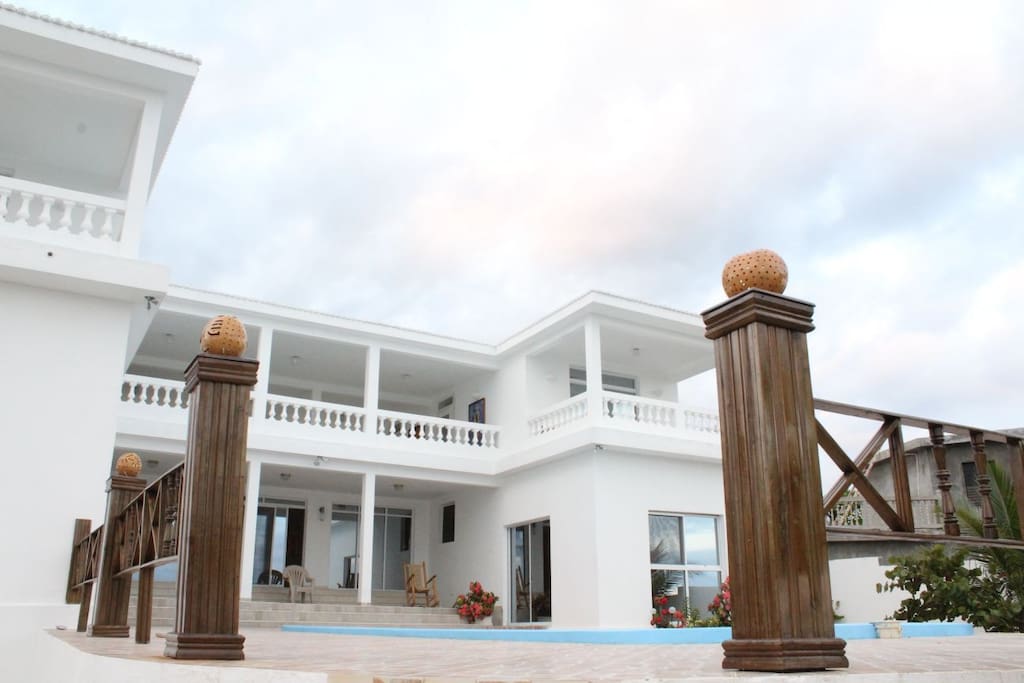
And if homes in Haiti were ranked into four tiers, I would say I live in the third tier of housing.  It is certainly above normal standards, but is not the nicest place you can find in Haiti.  Contrary to popular knowledge, there is money in Haiti.  And many people spend it on housing.  This can be seen in the example below.


What I would consider the upper tier of housing in Haiti
Check it out on AirBnB


While beautiful, the example above, and the conditions in which I live, are not the norm.  More than have the population lives off less than $2.42 per day...59% to be exact (source: World Bank).  The average person in Haiti can only dream of living conditions like mine...or most people in The States.  For most people in Haiti, they live in something equivalent to what you see below.


Common house in rural Haiti.
http://media.trb.com/media/photo/2010-11/84956460-18123248.jpg

The people owning these houses usually have some form of steady income and I would consider the equivalent of America's middle class.  Yet, they cook with coal, shower and clean with bucket water fetched by foot, and, depending on where they live, might have electricity.

But there are many people in Haiti who have been born into very unfortunate circumstances and money is extremely hard to come by.  Daily life is a grind.  These are the people living in what I would consider the lowest tier of housing in Haiti.  Just like above, there is no running water, no electricity, no cooking gas...no refrigerator.  But now, an outhouse serves as their toilet and even the structure of the house itself is questionable.  It is sure to come down in the hurricanes that frequent the region.  These people are the poorest of the poor.


Only 28 % of the population has access to improved sanitation, aka a flushing toilet.
Only 58 % of the population has access to an improved water source, aka a piped water source, not necessarily piped into their house.  (Source: CIA World Factbook)


These people are the reason I am grateful to have running water, electricity, a refrigerator, a toilet, a gas stove.  These people are the reason I consider myself fortunate.


Thanks Julie for pushing me over the edge to share this type of information that I didn't think people were interested in.


Saturday, June 4, 2016

I'd rather be surfing

I don't like the fact that non-profit organizations exist.  Yes, you read that correctly, I don't like the fact that non-profit organizations exist.  Those organizations providing services to vulnerable people that public and private programs cannot support.  I work for one.  I have collaborated with many.  But I dislike the fact they need to exist.  I want to live in a world where we don't need non-profit organizations to fill needs not met by public and private entities.  I want to live in a world where our public and private sectors ensure everyone has an equal opportunity to live a healthy and prosperous life, and supports those who unfortunately cannot.

Why must our society rely on non-profits to fill major gaps in support for the most vulnerable of persons?  Why, with all the money, technology, and intelligence in this world, cannot we not create a society providing everyone equal opportunity to live a healthy and prosperous life?  Why must non-profit organizations struggle to secure funding to provide basic services for the most vulnerable people?

I don't have answers to these questions.  So I continue to work for a non-profit organization, doing our best to provide people with the best opportunity to live a healthy and prosperous life.  I am dedicated to this work.... but I would rather be surfing.